

Google Just Drew Your Dealership's AI Marketing Roadmap. Here's How to Read It


Google just published its annual marketing playbook. Thirteen pages. Built for enterprise marketers running campaigns at the scale of Lufthansa, Dr. Martens, and General Motors.
Most dealers won't read it.
That's a mistake. Because buried in this guide is a roadmap your store can act on next month — and one of the three featured case studies is GM.
Google Marketing Live 2026 was Google's clearest signal yet about where consumer behavior is going and where ad dollars need to follow. It was also the most explicit Google has ever been about how artificial intelligence is reshaping every layer of the customer journey — from the moment someone wonders about a vehicle to the moment they sign the deal. I read the whole thing.
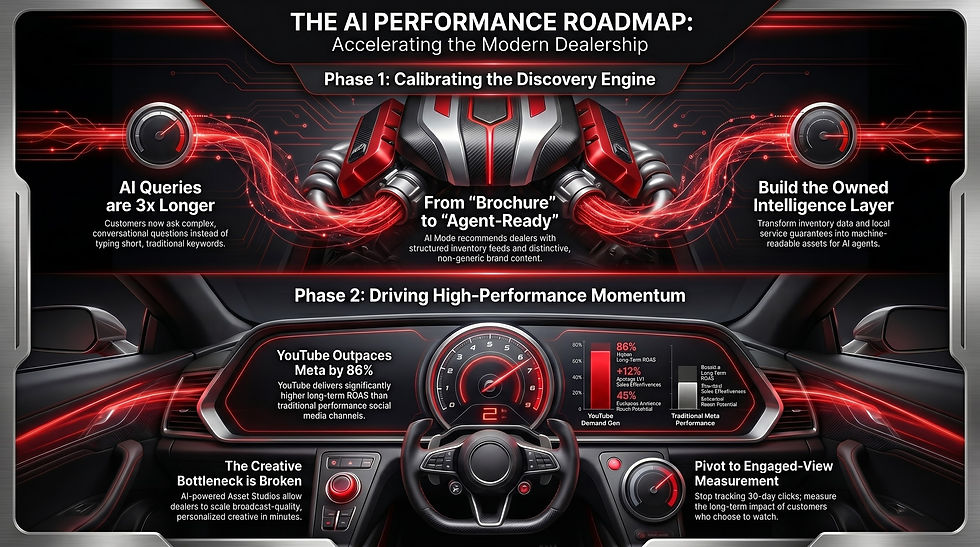
Here are the five shifts every dealer principal, GM, and marketing director should be tracking — translated out of enterprise language and into showroom terms.
After 19 years in this business and a thousand-plus dealerships in our rear view, I can tell you the gap between the dealers who win the next 24 months and the ones who quietly bleed market share won't be about budget. It will be about which operators saw these five shifts coming and which ones found out too late.

Search just broke. Your SEO playbook broke with it.
Google's AI Mode has surpassed one billion monthly users. AI Mode queries are three times longer than traditional Search queries. Last quarter, total Search queries hit an all-time high.
Translation: your customers are no longer typing "Silverado for sale near me." They're asking, "What's the best 2026 half-ton for towing a 24-foot boat under $65K with a 5-year warranty in my area?" — and getting a full, personalized answer before they ever click a website.
Read that again. The customer is getting a recommendation before your VDP even loads. Before any of your SEM bids fire. Before your BDC has a chance to follow up on a lead form that never happens.
This is the single biggest shift in the history of automotive digital marketing, and most dealers have not adjusted a single line of their content strategy in response.
Google's own guidance in the report is clear. To show up in AI Search, you need three things: lead with what only your brand can say, focus on helpful content, and be agent-ready.

That last one matters. Your VDPs, your inventory feeds, your About Us page, your "why buy here" content — that is what AI Mode reads when it answers a customer's question. If you sound like every other store within 100 miles, you don't surface. If your inventory data lives in seven disconnected vendor silos, you don't surface. And if your service department, finance department, and trade-in department all live behind generic stock copy your OEM provided, the AI has nothing distinctive to recommend.
The dealers who win the next 18 months are the ones who treat their content and feeds like a discoverable asset, not a brochure. That means real answers to real questions on every VDP. It means structured data on every page. It means an owned intelligence layer that captures what makes your store actually different — your specific lender relationships, your specific service guarantees, your specific community footprint — in a form an AI can read and recommend.
This isn't theory. The dealers I'm working with right now who are building this layer are already seeing AI Mode reference their stores by name in conversational searches. The ones who aren't are slowly disappearing from results that used to be their bread and butter.

YouTube is a performance channel now. GM proved it.
The most important dealership-relevant case study in the report is General Motors. GM paired premium YouTube placements with Demand Gen and drove a 3X return on investment on YouTube — not brand lift, not impressions, return on investment.
Let that sit for a second. This is GM. The biggest automotive advertiser on the continent. Reporting publicly through Google that YouTube is now a measurable, bottom-line performance channel that bridges brand storytelling and local dealership traffic across their entire portfolio.
The broader number is even louder. Google's commissioned MMM analysis found that YouTube delivers 86% higher incremental long-term ROAS than paid social.
Let me translate. Every dollar you've been pumping into Facebook and Instagram for performance is delivering roughly half the long-term return YouTube delivers. And 45% of YouTube Shorts users are not on TikTok. 65% are not on Instagram Reels. That's an audience you literally cannot reach from your current Meta-heavy budget.
The mechanism behind GM's result is worth understanding. Demand Gen is built on Gemini and pulls high-value signals from across YouTube and Google Search to capture moments of intent before they become explicit purchase queries.
The system isn't waiting for someone to search "2026 Sierra near me." It's identifying the family watching truck reviews on a Tuesday night, the contractor watching towing comparison videos on his lunch break, the woman researching family SUVs after her second baby was born. Then it serves them creative engineered for that moment.
Google's data shows that adding Demand Gen to existing Search and Performance Max campaigns delivers 10% higher ROAS and 12% higher sales effectiveness on average — and that's before you add the YouTube layer.
If you're a dealer principal sitting in a Q3 planning meeting and your media mix is 80% Meta, this report is the document you take to your agency. It is also the document you take to your OEM rep when they push back on YouTube spend. GM just gave you the case study. You don't need to invent one.
The dealers I'm coaching through this shift right now are starting with a simple reallocation test: take 15 to 25 percent of their monthly Meta performance spend and move it to YouTube Demand Gen for 90 days.
Within the first 60 days, almost every store sees a measurable lift in showroom traffic and engaged-view conversions. The ones that don't are usually running creative that doesn't translate to a watch-don't-scroll environment — which brings us to the next shift.
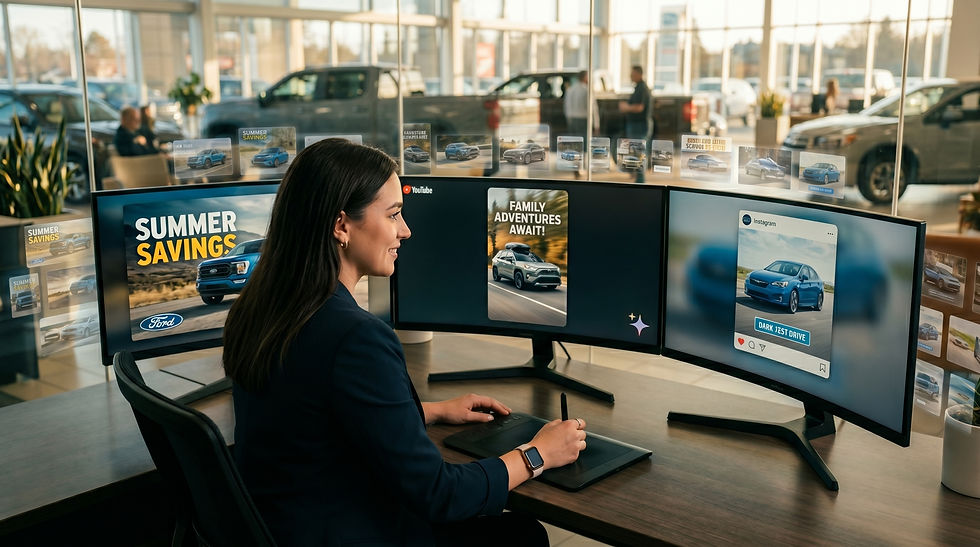
The dealership AI marketing creative bottleneck just broke
Creative drives nearly half of incremental sales — 49% according to NCSolutions. Half of every campaign result. And until now, the biggest reason most dealers couldn't compete with national brands has been production speed. They couldn't make enough fresh, on-brand, channel-specific creative to feed the algorithms.
This is the bottleneck that has held back our industry for 15 years. Every dealer principal I've worked with has had some version of the same conversation with their team: we need more video, we need more variations, we need to test more angles, we need to keep up with the platforms. And every time, the answer was the same — we don't have the production capacity, we don't have the budget, we don't have the time.
That excuse is gone.
Google's Asset Studio now bakes Gemini and Veo directly into Google Ads. The same AI models I've been telling dealers about for two years are now sitting one click away inside the ads platform itself. You can generate, test, and scale broadcast-quality creative in minutes, with built-in A/B testing across YouTube, Search, and Discover. Asset Studio also integrates with Canva, Adobe, and a new Google Labs tool called Pomelli built specifically to help smaller operators generate on-brand creative at scale.
Two implications for dealers:
First: the dealer down the street with a $20K/month creative budget and three production vendors no longer has a structural advantage over you. The playing field flattened overnight. A single marketing manager with the right intelligence layer behind them can now produce more high-performing creative in a week than a six-person agency could in a month.
Second: and this is the part most dealers will miss — the bottleneck isn't production anymore. It's the strategy, brand voice, and operating system driving what gets produced. Which is exactly the conversation I've been having about owned intelligence and operator-led dealership AI marketing for the last 18 months.
If your dealership's distinctive voice, your local expertise, your specific offers, and your team's actual personality aren't captured in a structured way that AI can pull from, you will produce a lot of generic creative very fast. And generic creative at scale just gets you to mediocrity faster than your competitors.
The dealers who win this shift won't be the ones who adopt Asset Studio first. They'll be the ones who built the intelligence layer that makes Asset Studio dangerous.

Your measurement is lying to you
Most dealers grade their YouTube and digital spend on click-through rates and 30-day attribution windows. Google just said that's wrong.
Engaged View Conversions are the new standard — they count the customer who actually chose to watch your ad before purchasing, not the one who scrolled past it.
Campaign Type Attribution gives Demand Gen an apples-to-apples comparison against Search and Performance Max. And the report explicitly tells marketers to look beyond the initial 30 days, because long-term ROAS is where YouTube and brand-building actually compound.

This is the section that requires the most courage from a dealer principal. Because if you adopt this framework honestly, it will force you to admit that your last three years of media reporting were measuring the wrong things.
If your dashboard only tells you what closed inside 30 days from a clicked ad, you are systematically underrating every brand and video investment you make. You are also handing your CFO the wrong number every month — which is why brand spend keeps getting cut first when budgets tighten. The dealer who fixes this conversation with their finance team in the next 90 days unlocks a budget conversation no one else in their market is having.
Google also introduced Meridian, an open-source MMM now integrated into Google Analytics 360, and two new measurement signals — Attributed Branded Searches for short-term intent and Qualified Future Conversions for long-term impact. None of these are out of reach for a serious dealer group. All of them are out of reach for a dealer running on click-through rate and last-click attribution.
If your CFO and your agency are still having a click-attribution conversation in 2026, Google just gave you the language and the data to change it.

Agentic commerce is coming. Be feed-ready.
Google introduced something called the Universal Commerce Protocol — a new industry standard built with Shopify, Walmart, Amazon, Target, Meta, Microsoft, Salesforce, and Stripe. It is not yet for auto. The direction, however, is unmistakable: shoppers will increasingly ask an AI agent to find them a vehicle, and the dealers whose inventory data is structured, fresh, and discoverable will surface. The dealers whose data is fragmented across vendors will not.
This is the section most dealers will dismiss as "not for us." It is exactly the section that will separate the next five years of winners from losers.
Think about how a consumer is going to buy a car three years from now. They will ask their AI assistant for help. The assistant will pull from a Shopping Graph that already contains 60 billion product listings. It will filter by exact criteria — budget, body style, towing capacity, warranty length, distance, financing eligibility. It will return three to five vehicle options with three to five dealership names attached.
Whose store gets named in that answer? The dealer who treated their inventory feed, their incentives data, their financing options, and their service offerings as a structured, accurate, real-time asset. Not the dealer whose VDP photos haven't been refreshed since the unit landed in inventory four months ago.
Google's specific guidance: make sure you have rich feeds with all your product details in Merchant Center. High-quality feeds are the difference between not showing up and being the exact answer. That guidance was written for retail. It applies in spades to automotive.

What to do next month
You don't need to act on every line in Google's report. You need to act on three things.
One: Get discoverable in AI Mode. Clean inventory data, helpful content on your VDPs, an About Us / Why Buy Here story that says something only your store can say. If your content is interchangeable with the dealer down the road, you're invisible to AI Search and getting more invisible every quarter.
Two: Shift a real share of your performance budget to YouTube Demand Gen. Start with a 90-day reallocation test if you need to. The GM case study, the 86% long-term ROAS gap, and the unique audience reach make this one of the easiest decisions in the report.
Three: Stop grading media on 30-day click attribution alone. Adopt Engaged View Conversions, look at long-term ROAS, and bring your CFO into the new framework before your competitor does. The dealer who wins the budget conversation wins the next two years.
Google didn't write this report for car dealers. But the entire industry just got handed a roadmap. The dealers who read it and translate it are going to compound the lead they already have.
The ones who don't will keep optimizing for a Google that doesn't exist anymore.
About the author:
Sean Cassy is a seasoned marketing professional with a passion for transforming businesses through powerful marketing strategies. With over 35 years immersed in the world of marketing, and as the co-founder and owner of Turbo Marketing Solutions for the past 20 years, Sean has a rich history in delivering results. He has personally crafted over 2,500 marketing funnels, edited 5,000 videos, and generated leads that have culminated in over $2 billion in sales for clients.
Sean’s deep involvement with AI marketing tools from companies worldwide, coupled with his vast experience in the automotive marketing industry, has uniquely positioned him as a thought-leader in the AI marketing space. He is now committed to leveraging his expertise to help businesses across all verticals seize the AI opportunity early, and gain a competitive edge.
Sean’s wealth of experience, continuous learning, and proven track record in delivering results, underscore his Expertise, Authoritativeness, and Trustworthiness in the field of AI marketing.


Comments